For most organisations, AI has so far meant a chat window. Staff ask a question, get a helpful answer, and then go back to their own systems to do the actual work: copy the details across, fill in the form, check the rules, chase the approval.
That is useful. It also leaves most of the work exactly where it was.
From answers to finished work
A chat assistant waits to be asked. AI that executes work is given a job inside a process, and it carries out the steps.
Take an application for funding or financing. When it arrives, the AI checks that every required document is there and flags what is missing. It compares the details against the eligibility rules, scores the application the same way every time, and writes a short summary of the key points. Then it places the case in the right officer's queue, ready for a decision.
The officer still decides. What changes is that the officer starts from a checked, scored and summarised case, instead of a pile of attachments.
The market is moving this way
Gartner predicts that 40% of enterprise applications will include task-specific AI agents by the end of 2026, up from less than 5% in 2025.
The same firm also expects more than 40% of agentic AI projects to be cancelled by the end of 2027, because of rising costs, unclear business value or inadequate risk controls. It warns of "agent washing", where existing chatbots and automation tools are simply relabelled as agents.
Both predictions point to the same lesson. Making AI take actions is the easy part. Making those actions trustworthy enough for a government agency or a regulated institution is where the real engineering lies.
Five rules for AI you can trust with work
These are the rules we build to, and the questions worth asking of any vendor.
- Give it a narrow job. One task, in one workflow, with clear limits on what it can read and change. An AI that screens applications has no business touching payments.
- Write the rules down, and let the system enforce them. Eligibility criteria, scheme conditions and Shariah requirements become explicit checks. When a rule says no, the system stops the action, whatever the AI suggests.
- Keep a person accountable for decisions. Approvals, rejections and payments stay with named officers. Malaysia's National Guidelines on AI Governance and Ethics, launched by MOSTI in 2024, list accountability among their seven principles.
- Record every step. What the AI read, what it concluded, which rule applied and who approved the outcome. An auditor should be able to follow any case from start to finish.
- Keep data where it belongs. Personal data stays under the organisation's control and within PDPA requirements, on cloud, hybrid or on-premise infrastructure as the data demands.
What it looks like in practice
Two of our own platforms show the pattern.
mvpAI is in production for a licensed Malaysian financial services provider, built into their existing system. It screens each application as it arrives, scores every application the same way whoever reviews it, and gives reviewers a summary to start from. Reviewers make every decision, with the routine checking already done.
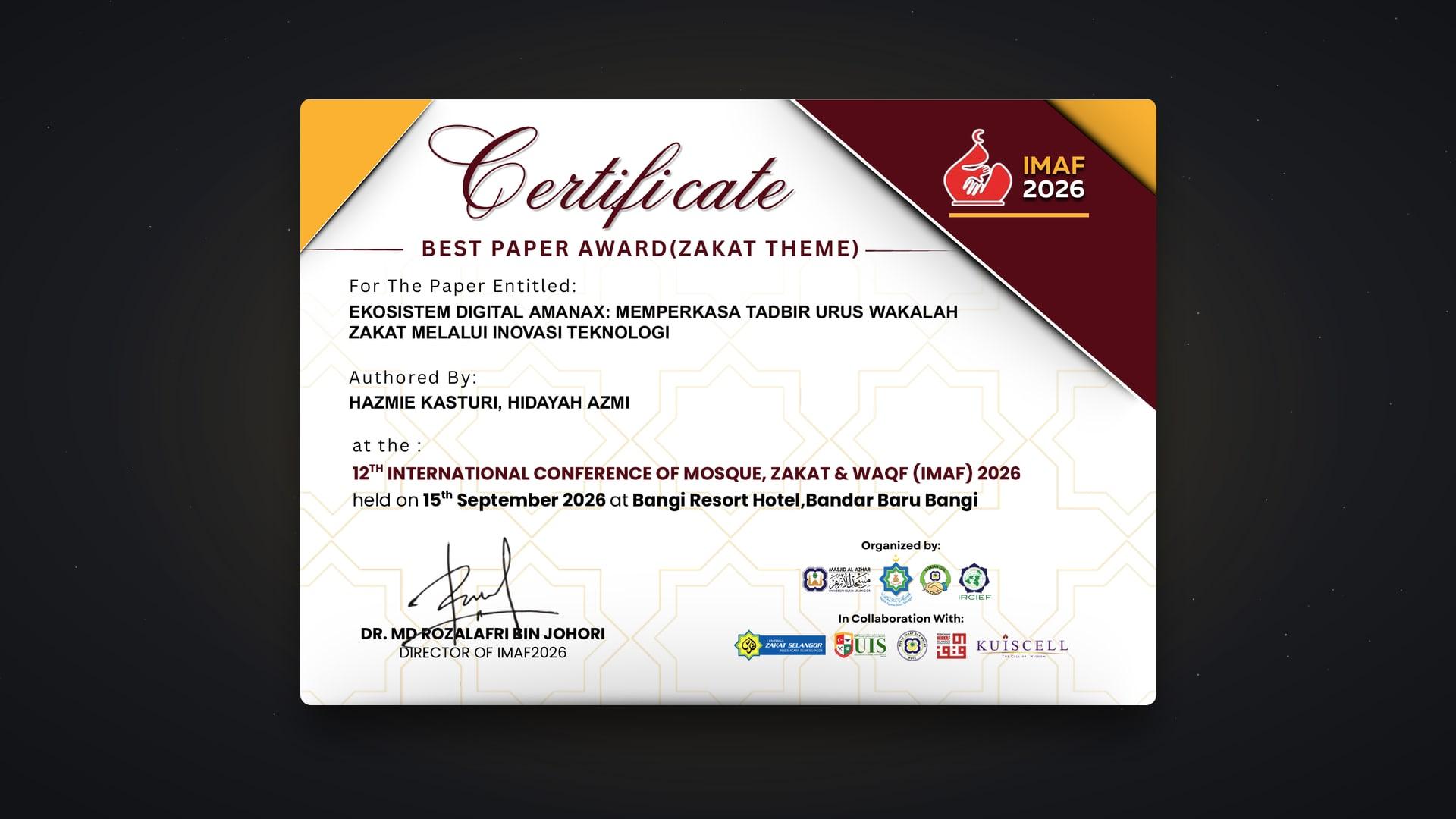
amanax shows the rules side of the same idea. Its engine classifies asnaf with an auditable trail of how each decision was reached, and blocks any distribution that breaks the scheme's rules before it is made. That work won Best Paper (Zakat Theme) at IMAF 2026.
Many steps in a good system need no language model at all. Executing work well usually combines AI for reading and judgement, rules for the things that must always hold, and a workflow that ties them together.
The value of AI is measured in work completed, checked and signed off.
Where to start
Look for a process in your organisation that fits most of these:
- It is repetitive, with judgement needed at only a few points.
- The volume is high enough that staff time is the bottleneck.
- The rules are already written down, in a policy, a guideline or a scheme document.
- The records are digital, or could be with modest effort.
A process like that is a strong candidate for AI that executes work. If you have one in mind, tell us about it and we will show you what it could look like inside your own systems.